
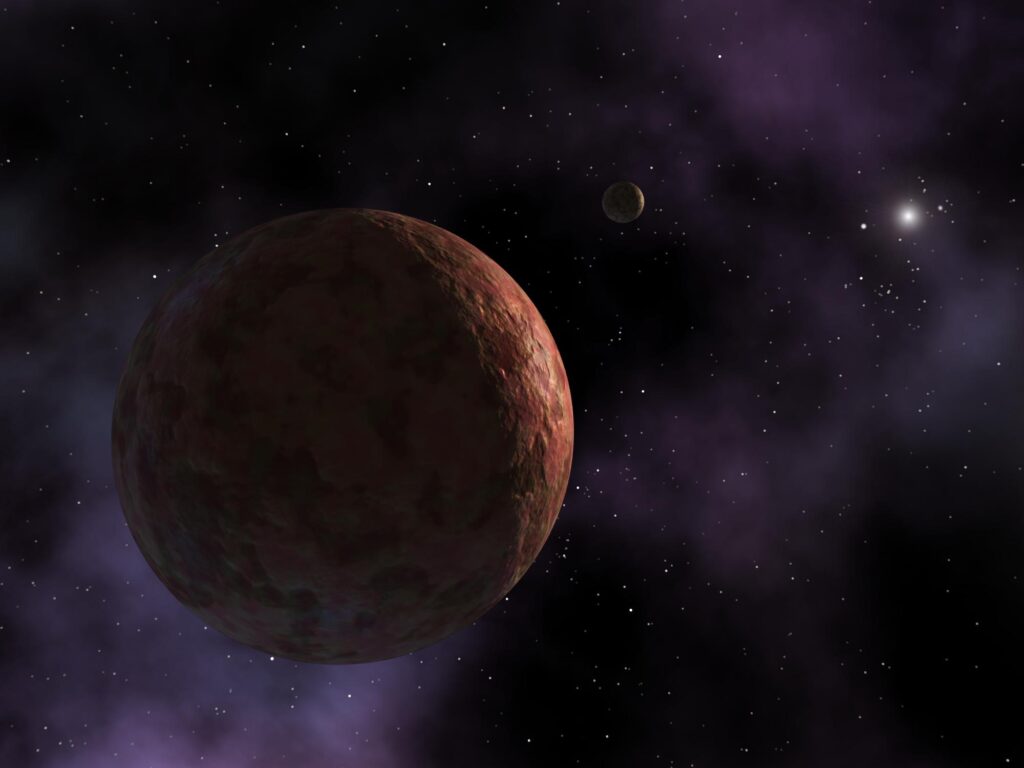
Out past Neptune, among the hundreds of icy bodies astronomers have catalogued, a stubborn minority refuse to behave. Some orbit at steep angles to the plane the planets share. Others swing around the Sun without ever coming close enough for Neptune to push them about. A study published on 23 November 2026 argues that the simplest explanation is a hidden planet beyond Neptune, roughly twice the mass of Earth, orbiting so far out that even at its closest the Sun would look like little more than a brilliant star.
The paper, in Monthly Notices of the Royal Astronomical Society (Lykawka, Bernardinelli and Horner 2026), comes from Patryk Sofia Lykawka of Kindai University in Japan and the University of Southern Queensland, with Pedro Bernardinelli of the University of Washington and Jonti Horner of Southern Queensland. The team calls its candidate Planet X2, a nod to Percival Lowell’s hunt for a Planet X that led to Pluto in 1930. It is not Planet Nine, the heavier world proposed in 2016 to explain an apparent clustering of distant orbits and now usually put at five to 10 Earth masses. Planet X2 is lighter, and its case rests on different evidence.
That evidence is a set of misfits. Most trans-Neptunian objects (icy bodies orbiting beyond Neptune) sit in the Kuiper Belt, between 38 and 50 astronomical units (au) from the Sun, where one au is the distance from Earth to the Sun. Three groups do not fit the usual story. Detached objects keep their closest approach beyond 40 au, out of Neptune’s reach. High inclination objects are tilted by more than 45 degrees. Then there are the extremes, such as Sedna, which never comes closer than about 76 au. Standard models of how the giant planets settled into place produce too few of all three.
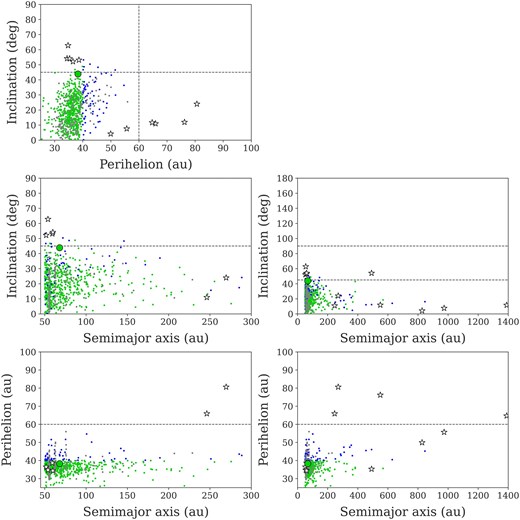
To test what might fix this, the researchers ran simulations spanning 4.5 billion years. Each began with Neptune migrating outwards through a disc of debris that included 1,500 bodies the size of Pluto, and a single run took four to five months on one processor. They tried two kinds of extra planet. The first was a set of Mars to Earth mass embryos formed among the giant planets and scattered outwards. These were thrown clear within a few million to a few tens of millions of years and left almost no trace. A distant planet on a stable orbit did far better.
The best matches put Planet X2 at about two Earth masses on an elongated orbit with a semimajor axis (the average of its nearest and farthest distances from the Sun) of 350 to 500 au. It never comes closer than 200 au and is tilted by only one to 15 degrees. Over billions of years its small, repeated tugs lift the closest approaches of icy bodies away from Neptune and tip their orbits. Without it, scattered objects outnumbered detached ones by 3.7 to one; with it, the ratio fell below one, in line with survey estimates. Extreme objects rose from 0.5 per cent of the distant population to between 44 and 68 per cent, enough to cover the orbits of all 11 known extreme bodies beyond 50 au.
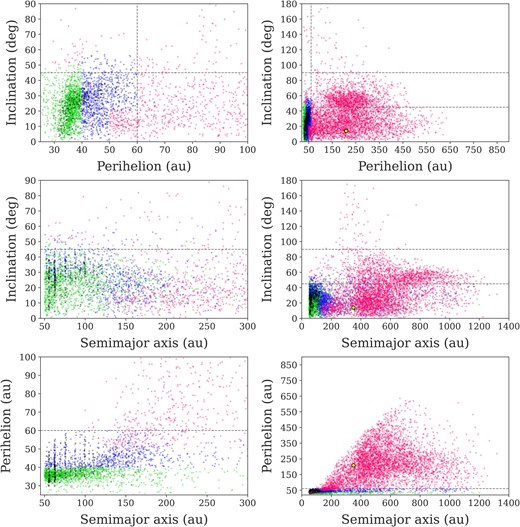
If the planet is real, the outer Solar System holds a record of a world it nearly lost. The authors suggest it could have formed closer in and been flung outwards, with its orbit later calmed by gas or by drag from surrounding debris, though their simulations do not model that origin. The result also sharpens the comparison with Planet Nine. A Planet Nine model of 6.2 Earth masses at 380 au turned 82 per cent of the distant population extreme, and the authors flag that it may tilt too many future comets, a point they leave for later work. Earlier work by Lykawka and Takashi Ito in 2023 pointed the same way, but without migrating giant planets; this study adds them.
The catch is that this is a simulation, not a sighting. When the team ran its models through a survey simulator for the Dark Energy Survey, which predicts what that survey’s camera could have caught, the inclinations and closest approaches matched well. The spread of orbit sizes did not. The models predict too few detections on larger orbits, a mismatch that is statistically significant. The authors suggest a primordial disc of debris extending beyond 50 au could close the gap, but that remains untested. The data are thin as well: about 95 per cent of that survey’s distant sample lies between 60 and 250 au, and only four Sednoids (Sedna’s distant cousins) are known.
A larger sample is on its way. The Vera C. Rubin Observatory’s Legacy Survey of Space and Time will catalogue far more of these distant bodies, and the orbital patterns Planet X2 predicts should either sharpen or fade as they arrive. As Horner put it in the Royal Astronomical Society’s release, “we now have an opportunity to put this idea to the test.”
Lowell’s Planet X grew from a puzzle that later evaporated, and still led somewhere. Planet X2 makes a cleaner bet. It names the orbits a hidden world should leave behind, and the next few years of sky surveys will show whether they are there.
