

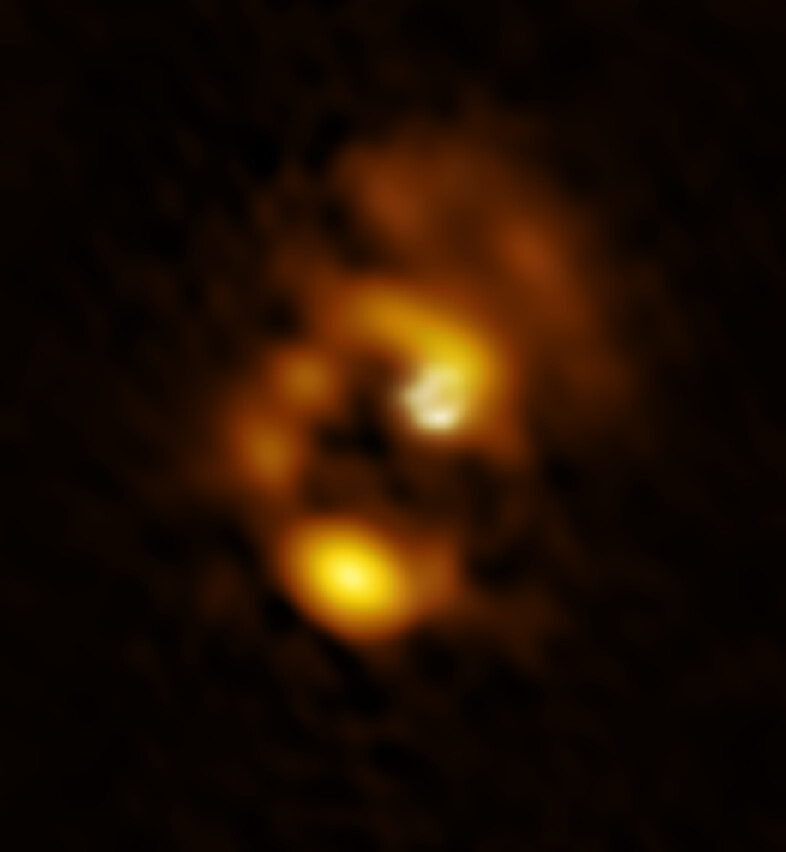
Much of the carbon and nitrogen in your body was made inside ageing stars and released when those stars let their outer layers drift into space. For decades, the accepted account of that drift has been a gentle one: starlight pushes on grains of dust, and the dust drags gas along behind it. Observations of Mira, a nearby red giant, now add a far rowdier mechanism. Using the Atacama Large Millimeter/submillimeter Array (ALMA), astronomers have caught a magnetic eruption on Mira that hurled a loop of gas several times wider than the star out into space, much as the Sun flings out coronal mass ejections.
The work comes from a team led by Wouter Vlemmings and Miora Andriantsaralaza at Chalmers University of Technology in Sweden and is described in two papers in Astronomy & Astrophysics. The first, on the eruption itself, rests on ALMA observations made on 10 August 2025. The second tracks bright hot spots on Mira’s surface across 19 sets of ALMA observations taken over roughly a decade. Chalmers announced the results on 23 November 2026, the same day the European Southern Observatory (ESO) made the ALMA image its Picture of the Week.
Mira lies about 330 light years away in the constellation Cetus. It is a star near the end of its life. It has swollen to a radius of about 1.5 astronomical units (au), where one au is the distance from Earth to the Sun, and it slowly brightens and fades as it pulsates. Placed where the Sun is, its surface would sit close to the orbit of Mars. The Sun should reach a similar stage in a few billion years, which makes Mira a preview of our own star’s old age.
Seeing magnetism on a star that far away takes some ingenuity. In the dense gas around Mira, silicon monoxide molecules act as natural masers, the microwave equivalent of lasers, producing intense and sharply defined beams of radio emission. Under the right conditions, the polarisation of that emission (the direction in which its waves vibrate) lines up with the local magnetic field. Map the polarisation and you have mapped the field.
The August 2025 images show the masers strung along a loop that reaches about 10 au beyond the star’s surface, roughly the distance from the Sun to Saturn. The polarisation follows the curve of the loop. From it, the team derives a magnetic field of at least 0.7 gauss inside the ejected gas, and a mass of at least 1.1 millionths of a solar mass, about a third of the mass of Earth. That material left the star at roughly 35 kilometres per second, close to the speed needed to escape it altogether.
Running the loop’s expansion backwards puts its launch between mid 2023 and early 2024, and that points to a cause. The second paper had already recorded a hot spot on Mira’s south-west quadrant in June 2023, more than 4,200 kelvin hotter than the surrounding surface, which glows at around 2,000 kelvin at these wavelengths. The loop’s foot sits in that same quadrant. By the team’s estimate, the eruption’s energy exceeds that of typical stellar superflares by up to several orders of magnitude.
That matters well beyond one star. Mira’s steady wind is thought to remove a few ten-millionths of a solar mass each year, so this single outburst carried off at least a few years of ordinary mass loss in one go. An earlier ejection, launched in late 2010 or early 2011, contained around a hundred-thousandth of a solar mass. Dust appears only at the outer edges of these ejections, which suggests the dust forms because of the outflow rather than driving it. Vlemmings says the result changes “a fundamental part of the origin story of the atoms” we are made of. If such eruptions are common, they could also explain why the planetary nebulae these stars leave behind are so often lumpy and lopsided.
There are caveats, and the authors are candid about them. The loop is an idealised model fitted to scattered maser spots, which only shine where density and velocity happen to favour them, so the true shape may differ. The magnetic field and the ejected mass are both lower limits, and around 30 per cent of the material is moving too slowly to escape and should fall back. Nobody yet knows where such a strong field comes from. A churning dynamo in the star’s convective outer layers is one candidate; a swallowed companion or giant planet is another, though that would probably leave the star spinning, and no rotation has been detected on Mira. This is also a single star, with a white dwarf companion of its own.
Astronomers in the 1600s named the star Mira, Latin for the wonderful one, after its habit of appearing and vanishing from the naked-eye sky. The name now fits for a different reason. If the Chalmers team is right, stars like the Sun do not simply exhale their outer layers in old age. They lose them in storms, and some of what those storms throw out ends up in the next generation of planets.
