

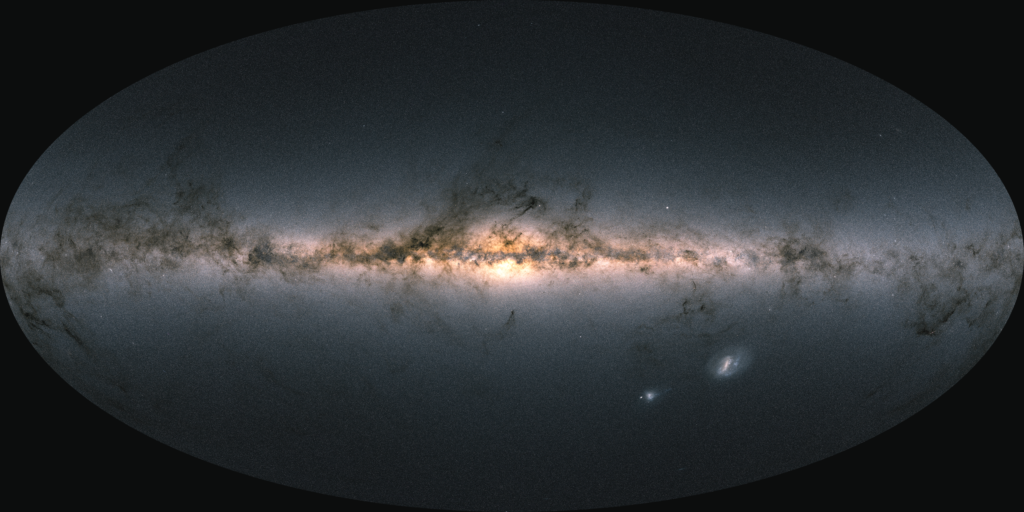
The oxygen we breathe was forged inside stars, flung out by their explosions and stirred through the galaxy for millions of years before it reached the cloud that became the Sun. Following that journey on a computer has always involved a compromise. Galaxy simulations lump many stars into a single particle, so the individual supernovae that drive the mixing get averaged away. A new Milky Way simulation is fine enough to drop the compromise.
Led by Keiya Hirashima of RIKEN and Michiko Fujii of the University of Tokyo, the work is a finalist for the 2026 ACM Gordon Bell Prize and was presented on 17 November at the SC26 supercomputing conference in Chicago. Called PHEASANT, it follows up to 5.4 trillion particles, each carrying just 0.22 times the mass of the Sun. That is fine enough to represent the galaxy star by star, and the team puts it at roughly four orders of magnitude, or about 10,000 times, beyond conventional galaxy simulations.
Time, not size, is the hard part. Gas blasted out by a supernova changes so quickly that a direct calculation needs steps of around 100 years, and that pace would drag down the whole galaxy. Hirashima built an AI surrogate model, a neural network trained on detailed explosion simulations, that predicts where the gas will be 100,000 years later. The galaxy can then advance in far longer strides, which the University of Tokyo release says makes the calculation about 20 times faster.
Three exascale machines built around different chips run the same code: Frontier and Aurora in the United States and JUPITER in Germany. On Aurora it used 60,236 graphics processors and handled up to 144 billion particles a second. Portability sounds dull. It means a simulated galaxy can eventually be set against star-by-star surveys from Gaia and the Vera C. Rubin Observatory.
For now, this is a performance demonstration rather than a finished portrait. The team reports that the simulated star formation rate matches estimates for the real Milky Way, but the model still lacks radiation from young stars and the bubbles of ionised gas they inflate. Much of the gas physics also still runs on ordinary processors, and the researchers say they have not yet simulated how a galaxy like ours forms in the first place.
Next come runs meant to be science rather than benchmarks. If they deliver, the origin of the Sun’s raw material becomes something researchers can trace, one exploding star at a time.
