

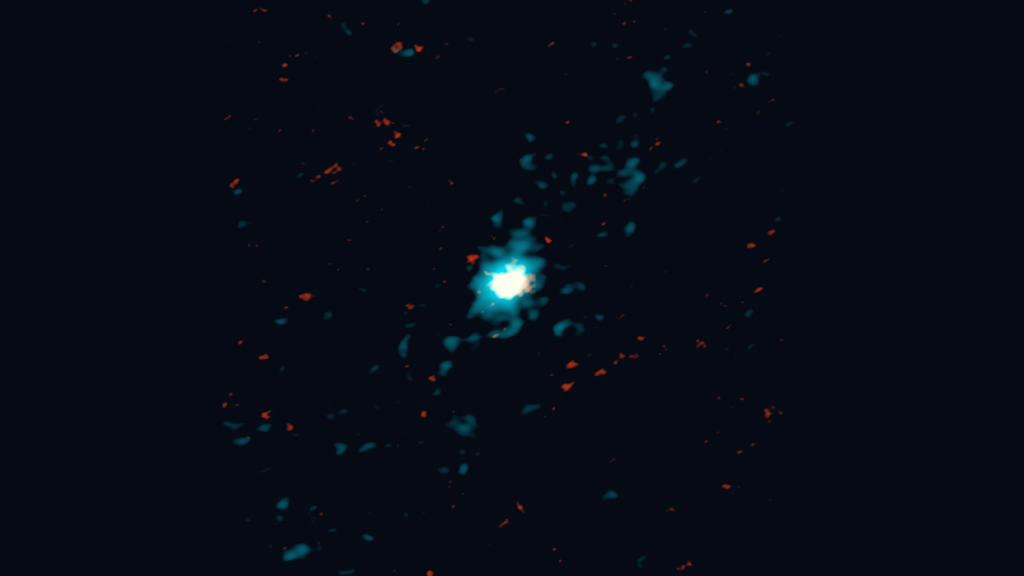
Most of what astronomers know about the weight of the earliest giant black holes rests on a borrowed rulebook. They measure how fast gas whirls in a quasar’s glow, feed that into relations calibrated on nearby galaxies, and trust that the same rules held when the universe was young. Now a team using the Atacama Large Millimeter/submillimeter Array (ALMA) has tested that trust directly, measuring a black hole mass in a galaxy seen when the cosmos was about 1.3 billion years old from the way the black hole’s gravity stirs the gas around it.
The target is WISE J224607.56-052634.9, mercifully shortened to W2246-0526, one of the most luminous dust-obscured quasars known. Its light has travelled for more than 12 billion years to reach us. The team, led by Mai Liao of the National Astronomical Observatories of the Chinese Academy of Sciences and Universidad Diego Portales in Chile, puts the black hole at about 6.5 billion times the mass of the Sun. The study appears in Science Advances and was announced on 20 November 2026 by the ALMA Observatory.
Everything hinges on the sphere of influence: the region near a galaxy’s centre where the black hole’s gravity outweighs that of all the surrounding stars, gas and dark matter. Inside it, gas should move faster the closer it sits to the black hole, much as Mercury outpaces Neptune around the Sun. ALMA followed two kinds of gas, ionised carbon, which glows brightly at far-infrared wavelengths, and a highly excited form of carbon monoxide that marks dense, hot gas. At its sharpest, ALMA can pick out features about 700 light-years across at this distance.
Untangling the signal took work. The galaxy is laced with outflows, gas being driven away by the quasar at hundreds of kilometres per second, and these blur the measurements. After modelling and removing them, the team found that the spread of gas speeds climbs steeply towards the centre. That rise is the fingerprint they were looking for. Fitting it gives 6.5 billion solar masses, and the carbon and carbon monoxide data each give a consistent answer on their own. In Liao’s words, the team could “see the black hole’s gravity imprinted on its surroundings”.
Earlier attempts to do the same for unobscured quasars, at even greater distances, came up empty. One explanation is that intense X-rays from an exposed quasar strip extra electrons from carbon atoms near the centre, dimming exactly the emission astronomers want to follow. W2246-0526 is wrapped in so much dust that its visible light is dimmed by about 15 magnitudes, a factor of roughly a million. The researchers suggest this shroud shields the inner gas, letting carbon survive close enough to the black hole to act as a tracer. Heavily obscured quasars may therefore be the best places to repeat the trick.
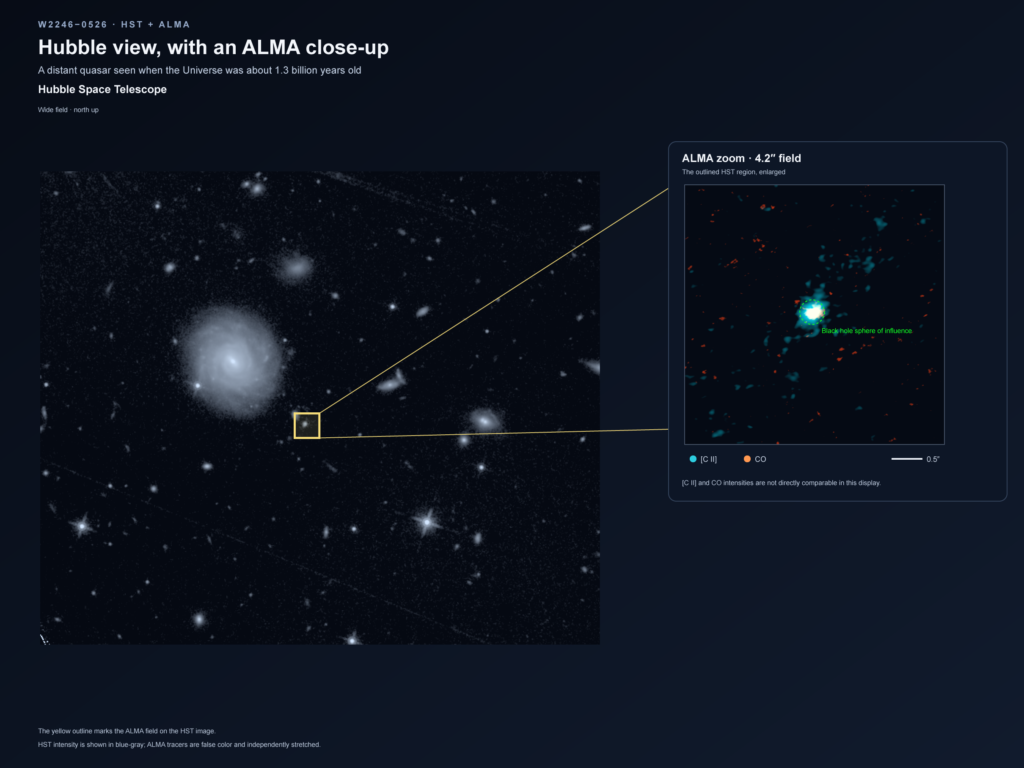
The result offers a rare check on the usual shortcut. An earlier estimate for the same object, based on the width of a magnesium emission line and the quasar’s brightness, gave about four billion solar masses with wide error bars. The two agree within those uncertainties, which suggests the indirect method is not badly off even for one of the brightest quasars known. Almost every black hole mass quoted for the early universe leans on such relations, so a direct test, even a single one, carries weight.
It also hints that this black hole is outsized for its home. Set against the relation between black hole and host galaxy masses seen nearby, W2246-0526 sits well above the line, as do several similar obscured quasars. The black hole appears to be feeding faster than the Eddington limit, the rate at which the outward push of its own radiation should balance gravity’s inward pull.
There are limits. This is one galaxy. The authors caution in the paper (also available as an arXiv preprint) that their quoted uncertainties may be too small because of systematic effects. Depending on the modelling choices, the mass ranges from about 5.2 billion to 7.8 billion Suns. The size of the sphere of influence is loosely pinned down, somewhere between roughly 1,300 and 4,500 light-years in radius. Alternatives such as a dense central knot of stars fit the data worse and would need a star cluster more than ten times heavier than any yet seen. The host’s stellar mass is itself uncertain by more than a factor of 10, so exactly how far the black hole outstrips its galaxy remains open.
The carbon monoxide observations were taken on 9 December 2025; the ionised carbon data date back to 2017. Together they turned a smudge of light into a set of scales. If obscured quasars really do protect their inner gas, the coming years could bring enough of these direct weigh-ins to show whether early black holes truly outgrew their galaxies, or whether astronomers have simply been reading the old rulebook wrong.
