

A push no stronger than the weight of an AA battery resting in your hand sounds like a poor way to cross the Solar System. Yet that is how the Psyche spacecraft will spend most of the next three years: thrusting gently, almost without a break, until it reaches a metal-rich asteroid in the main belt between Mars and Jupiter. NASA confirmed on 22 October 2026 that the probe has settled into this near-continuous cruise, and the approach shows how patient engineering can beat brute force in deep space.
The mission launched on 13 October 2023. For its first leg, the spacecraft fired its engines only now and then, saving propellant while it lined up for Mars. On 15 May 2026 it passed within 4,609 km of the Martian surface, and the planet’s gravity added about 1,600 km/h (1,000 mph) to its speed and tilted its orbital plane by around one degree, all without burning any fuel. On 28 September the team switched to near-continuous thrust. The spacecraft now pauses only once a week to check in with controllers, and its engines should run about 90% of the time until arrival. Navigation lead Don Han at NASA’s Jet Propulsion Laboratory (JPL) put it simply: “It’s now ‘pedal to the metal’ to the asteroid Psyche.”
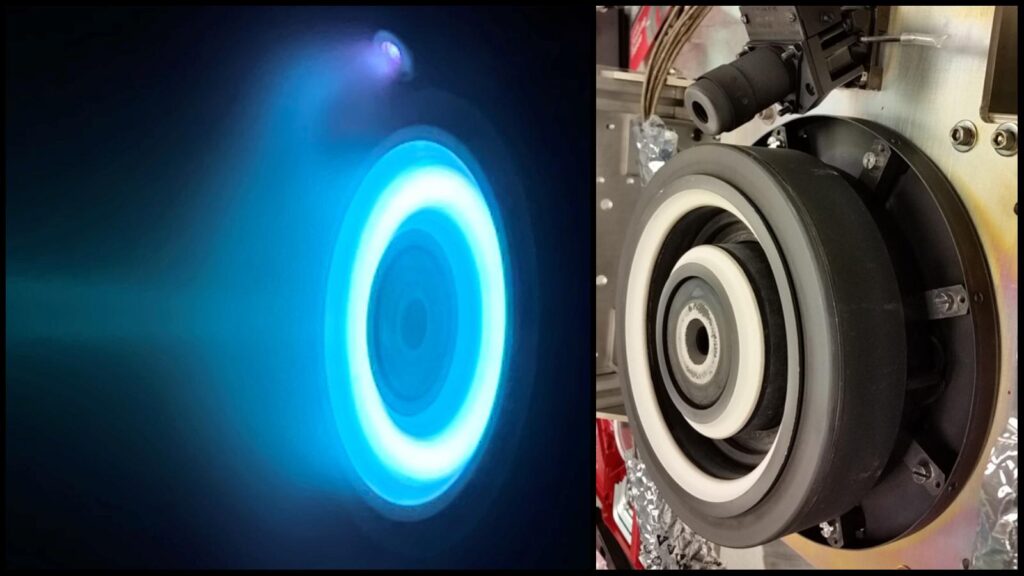
Psyche’s engines are Hall-effect thrusters, a form of electric propulsion. Instead of burning chemicals, they use electricity to turn xenon gas into charged particles called ions and expel them at high speed, which produces both the thrust and a pale blue glow. The spacecraft carries four of them and runs one at a time. Each delivers at most 250 millinewtons. The secret is persistence: a tiny force applied for months on end builds into serious speed, and NASA expects the spacecraft to peak at more than 160,000 km/h (100,000 mph) relative to an observer on Earth.
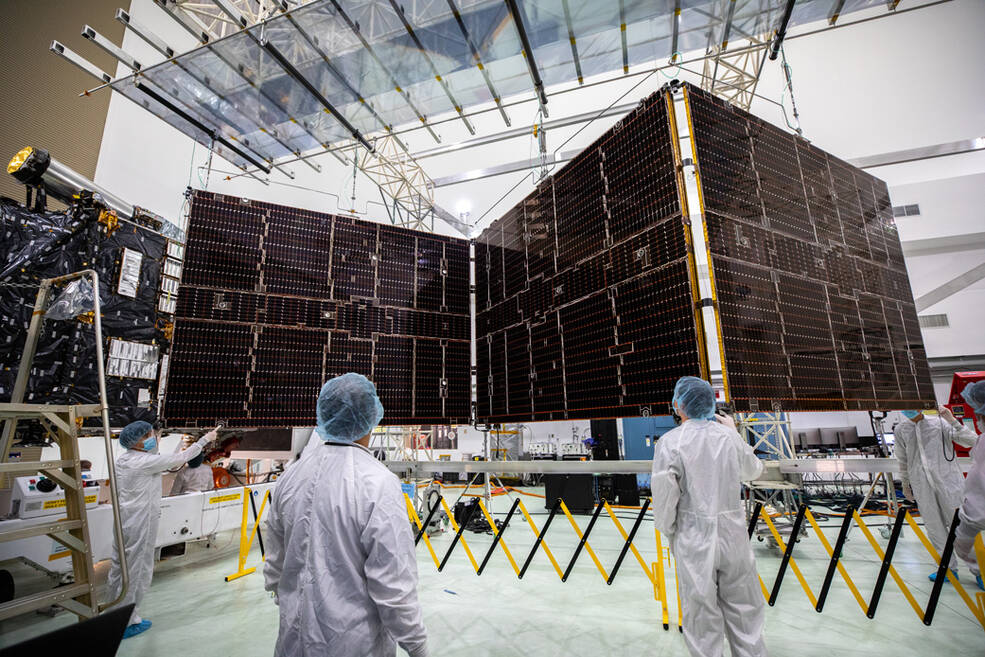
That frugality is the whole point. At launch the spacecraft carried nearly 1,090 kg of xenon in seven tanks, and after three years in space it has used only about a third of it. Power comes from two cross-shaped solar arrays with 75 square metres of collecting area, the largest ever deployed at JPL. Near Earth they generate more than 20 kilowatts. Out at the asteroid, sunlight is so much weaker that output drops to just over 2 kilowatts, roughly what a hair dryer draws. So the thrusters will run at full power for only the next three months before being throttled back to about half as the craft moves farther from the Sun.
Continuous thrust brings its own housekeeping. The swirling ions give the spacecraft a slight twist, which would slowly spoil its pointing if nothing resisted it. Spinning reaction wheels soak up that twist, but they can only store so much. Every several hours, engineers switch off the main thruster, rotate the spacecraft and fire a different thruster at low power for a few minutes to bleed off the stored momentum. It is the interplanetary equivalent of pulling over to stretch your legs.
The destination justifies the effort. Asteroid Psyche, first spotted by the Italian astronomer Annibale de Gasparis in 1852, is about 280 km across at its widest and orbits between 378 million and 497 million km from the Sun. Scientists think it may be part of the core of a planetesimal, one of the early building blocks from which rocky planets grew, stripped bare by violent collisions. No drill will ever reach the iron heart of Earth. A body that might show what a planetary core looks like from the outside is the next best thing.
That idea is shakier than it once was. Psyche was long described as a lump of metal, but radar and thermal measurements now point to a mix of rock and metal, with metal making up somewhere between 30% and 60% of its volume. Its true appearance will stay unknown until the spacecraft arrives. The Mars flyby gave the team a useful rehearsal, letting them calibrate the cameras, magnetometers and gamma ray and neutron spectrometer against a well studied planet. Still, the real work only begins in 2029, and three more years of near-constant thrust is a long time for any machine.
If all goes to plan, Psyche will reach its target in summer 2029 and spend two years in orbit, working gradually lower and then higher as it maps the surface. There are no dramatic engine burns on the way, no fiery manoeuvres to watch. Just a faint blue glow, pushing a spacecraft the size of a singles tennis court towards a world nobody has seen up close, a quarter of a newton at a time.
